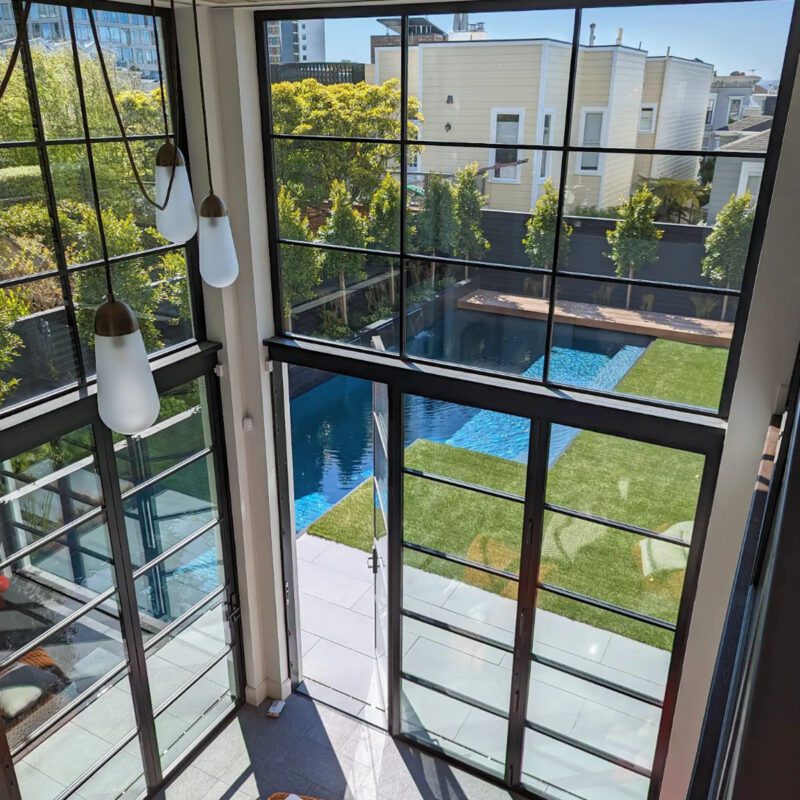
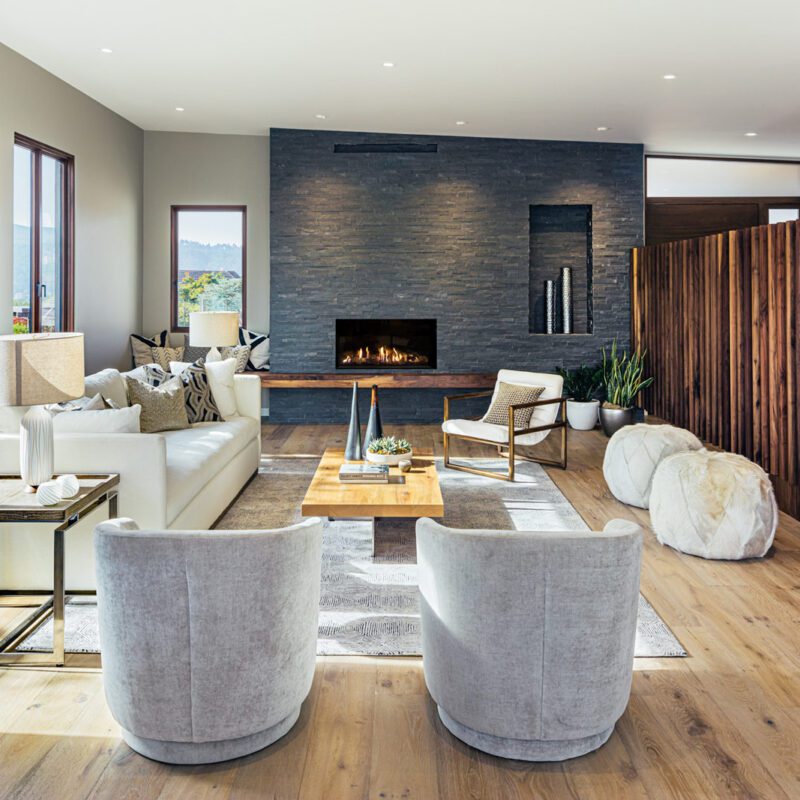
A stairwell in this mid-century modern Bay Area home becomes a light showcase with two well-integrated skylights. Wood accents and a modern metal stair rail are highlighted by the midday sun.
The San Francisco Bay Area region’s dramatic climate—from the dense fog of San Francisco to the bright East Bay sun—presents unique challenges for illumination. Beyond placement, the choice of glass technology, including Low-E coatings and smart glass, is crucial for balancing abundant light with the critical needs of thermal performance, energy efficiency, and glare control. By expertly considering the regional climate and a home’s orientation, AT6 Architecture + Design Build President, Jason Langkammerer demonstrates how these design decisions transform a home’s atmosphere, turning natural light—especially through well-designed skylights—into a defining, dynamic, and essential element in your Bay Area home remodel.
Natural light makes any space welcoming, connecting us to the outdoors and our circadian rhythms even when we have to be inside. We feel good in light-filled rooms. When that light comes from above, a sense of mystery is added, the brightness being obvious but the source less so.

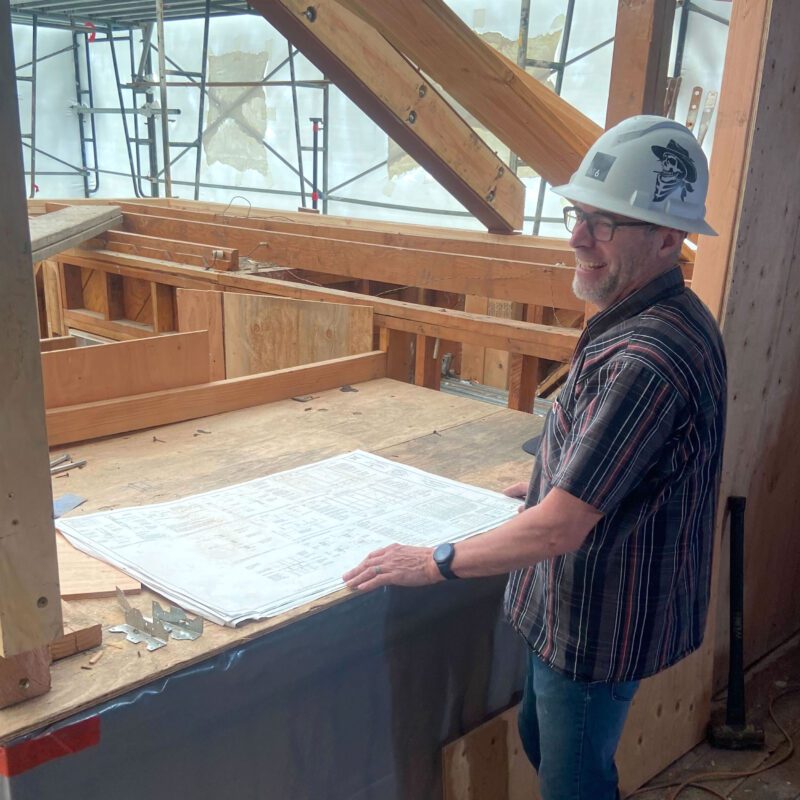
In this modern San Carlos remodel, AT6’s Jason Langkammerer and Anthony Gilleece discuss the advantages of the skylight’s placement and orientation.

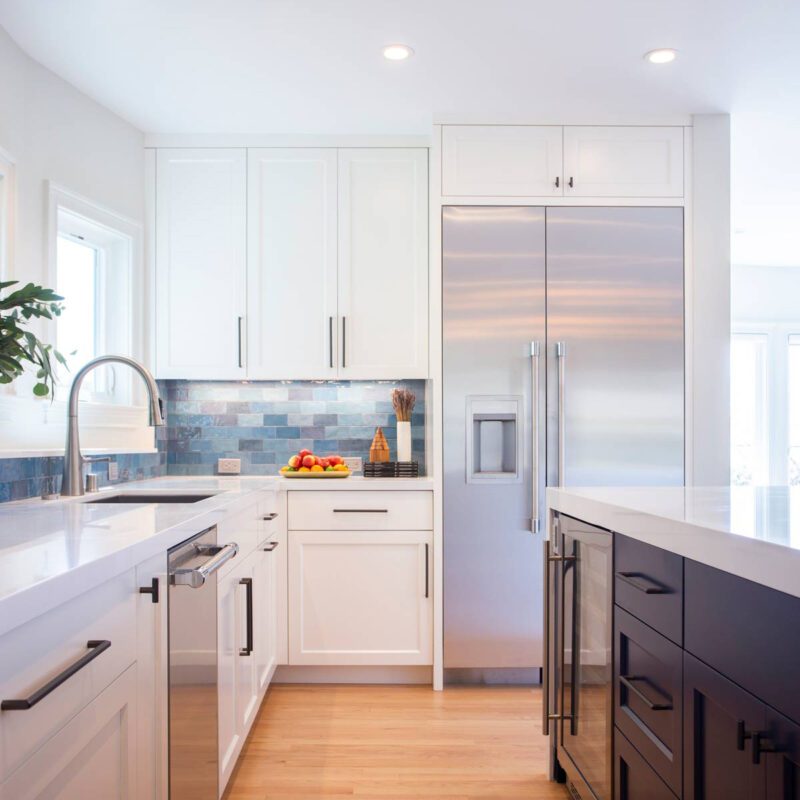
Jason and Anthony fine tune the installation of the cabinets while the finished skylight overhead adds much needed light to this San Carlos kitchen.
Skylights are a great way to light a space and can be positioned for different effects—washing light down a wall, focusing it on a special place, or just brightening an entire room or space. Operable (opening) skylights add the benefit of effective ventilation, creating a natural fan effect when a window is opened, and drawing heat out of the house. Because skylights sit on the roof, these “roof windows” can be oriented in different directions and bring light in throughout the day, brightening spaces in a way windows alone cannot.
Where skylights work well—and where they don’t
While skylights are a terrific source of light, they are especially suited for some situations, and less so for others. They generally work well on flat or northern-facing roofs in the northern hemisphere, like the homes we work on in San Francisco and the Bay Area, creating a softer, glowing light. This works very well for art studios and places where direct light might be too harsh. A breakfast nook can benefit from a skylight facing east, effectively bringing in the low morning light. Here are a few broader conditions to consider.
Urban housing with few to no side-window options
Urban houses are often either very close to or actually touching their neighbors, leaving side windows either out of the picture altogether or unable to draw in much light. Skylights are an effective way to bring light into the darker middle of the house, especially in central hallways to make them feel more open, or in rooms on the side of the house that have no place for direct natural light. These kinds of homes are in abundance in San Francisco neighborhoods like Noe Valley, Pacific Heights, NOPA, North Beach, and others.
Very sunny or hot climates
Very sunny or hot climates can be the wrong place for skylights. Any light that enters the house needs to be shaded in these environments, but even skylights with integral shades will heat up, raising temps in the interior. In these locations, high windows with an overhang will be much more effective at letting in indirect light without adding heat gain to the equation. Low winter sun can get in those windows and passively heat the building in the colder months.
What advantages do skylights offer besides light?
Aside from their obvious brightening abilities, skylights offer home design benefits, as well as health, energy efficiency, and security.
Design
Skylights give architects a creative tool for drawing out the mood of a room, highlighting art or other objects, and “sculpting” light within a space. Using color in the skylight shaft ushers in the color-tinted light, another creative option. Skylights themselves are rarely a focal point, but the glass filters and shapes the light to become a design element.

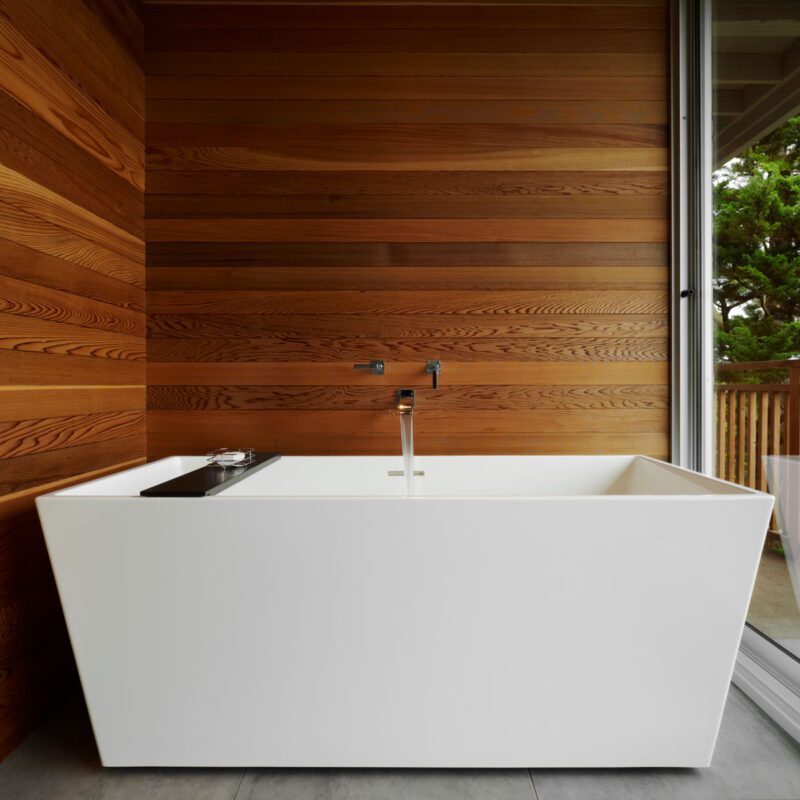
A light filled bathtub shows how this bay area home remodel thoughtfully incorporated a bathroom skylight as a design feature.
Health
Fresh air is as important as natural light to our health and well-being, and skylights offer another way, in addition to open doors and windows, to move air through the house and keep it from getting stale or too hot. Natural light also helps regulate our circadian rhythms, which research is finding more and more important to good health.
Energy efficiency
Skylights can passively cool a space, particularly in the shoulder seasons, making air conditioning or other mechanical means of cooling less necessary. Open a low window on the cool, northern side of the house and crack an operable skylight and the natural laws of physics create a cool breeze through the home. In winter months, the sunlight they capture can passively heat the house by a few degrees. While they are not as insulated as the roof around them, making them less energy efficient in their footprint, they can still be an effective part of a home’s heating and cooling strategy. San Francisco’s daily fog streams in through skylights, cooling down homes in the late afternoon.
Security
In urban areas like San Francisco, skylights offer a private connection to air and light, with roof skylights opening up to only the sky above them in dense city neighborhoods like North Beach or Pacific Heights. While keeping a window open at night for fresh air might not feel entirely safe in some cases, cracking a skylight can bring in the cooler night air and still offer a sense of security that an intruder won’t come in, as well..

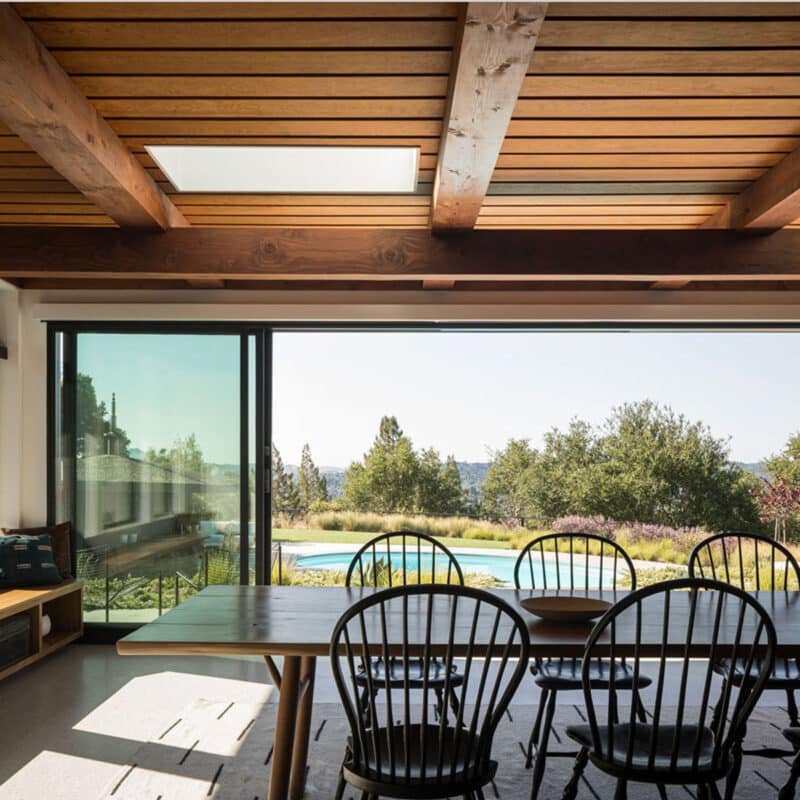
This remodeled Lafayette mid-century modern home’s indoor/outdoor living is accentuated with natural light coming in from many directions, including two skylights which brighten the light terrazzo flooring.
Skylight Functionality
Depending on whether your needs are for light, air circulation, or both, there are two different types of skylights to consider, fixed and operable. In addition to different functions, they come with scaled price tags, depending on their type, size, and standard versus custom sizing.
Fixed skylights
A fixed skylight is essentially a roof window for light only. Its simplicity makes it considerably less expensive than operable skylights, so it can be a cost-effective option when needing to customize the size of the skylight to an existing space. Skylights come in both standard and custom sizes, with the latter being more expensive but necessary in many cases where there is no spatial flexibility.

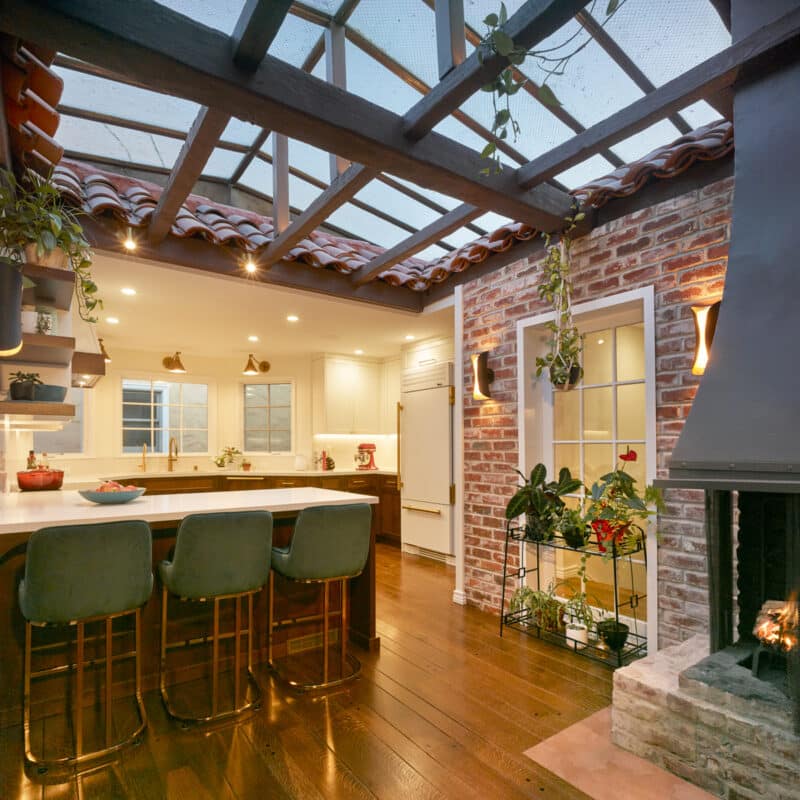
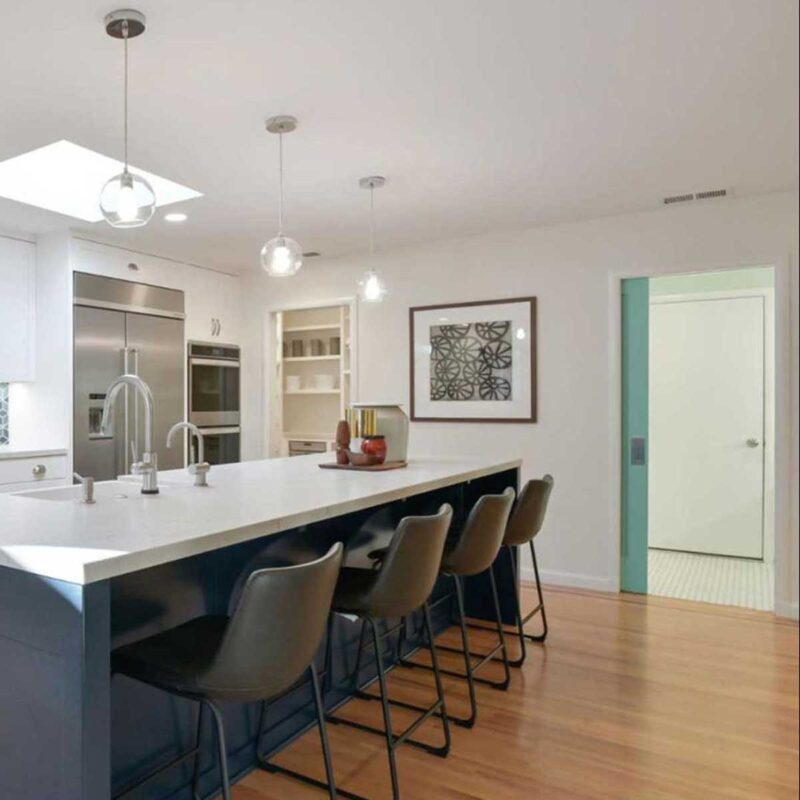
In this modern remodel in this bay area home, the fixed skylight in the kitchen brings in natural light that is reflected in the light surfaces.
Operable skylights
Operable skylights open to allow for passive cooling and air flow. They also come in standard or custom sizes, with both options being more expensive than fixed skylights of either type.
Skylight control options
Usually, because of their location in the ceiling, it’s fairly hard to reach up and open a skylight. Although operating a skylight with a crank on a pole is still the lowest cost option, thankfully today’s models have cost-effective technological advances to how they can be operated. Some feature small solar panels that allow for battery-powered operation from a remote control. These also feature a rain sensor that will automatically close the skylight when precipitation starts. Controllers can be simple, two-button devices, but there are also upgraded versions that allow you to control multiple skylights from one app on your tablet or phone.

This skylight frames the perfect sitting spot at the top of this Noe Valley home’s landing. The indirect light from above the cozy bench illuminates the design details of the home, opens wide to provide an al fresco reading perch, and also provides a view from the top level of the home.
What material are skylights made of?
Modern skylights for use in a home typically feature energy-efficient, laminated safety glass held within aluminum frames for superior insulation and durability. The exterior is protected by powder-coating and flashing to ensure a weather-tight seal against the elements.
How do I choose the right glazing for my skylights?
Insulation codes require most skylights now to be dual-pane rather than single. The material can be clear or translucent; clear skylights offer a nice view out and sense of connection to the exterior, while translucent ones tend to create a nicer glow, especially when the light is shining directly in. Some people find that direct light can be harsh with clear skylights.
Clear skylights, however, show any sort of buildup much more clearly than translucent ones, even if the rain rinses them off. Which brings up an important aspect of installing skylights: they should always be pitched so that water runs off the glass rather than evaporating and leaving water marks.
In harsher climates, triple-paned skylights might be advised, and tinting is available. You can also use interior shades if you need to cut light in those climates.
Curb-mounted skylights vs. deck-mounted skylights
The way the skylight is attached to the roof has a bearing on appearance, but the primary differences between deck-mounted and curb-mounted skylights have to do with construction sequencing and design flexibility.

Deck-mounted skylights are integrated directly into the roof, so that only the depth of the skylight sits above the roofline. It can be cheaper to install than a curb mount, but must be done well to avoid leakage.
This setup is not advisable on flat roofs, where the water pools for longer.
In a curb-mounted installation, a small curb is built above the roofing, providing the base for the skylight. The skylight sits on the curb, slightly above the roof. Curbs can be built almost anywhere on the roof, and can be built to a different slope than the roof, allowing for more design options and functions. You also have better control over the roof seal because the roof membrane is brought up the side of the curb and the skylight sits over it. Curb-mounting makes it easier to repair a leak—the lack of integration with the roofing means less tearing out. If the skylight cracks or gets old, you can easily take the old curb-mounted one off and put a new one on. It’s more visible from the outside than a deck-mounted skylight, but also has much more flexibility.
Are skylights prone to leaking?
Any junction at a wall or roof opening is prone to leakage, including windows and skylights. The seam between two different materials—windows and a wall, skylights and a roof—is the weak spot in any waterproofing system, with two materials expanding and contracting over time. This can occur at chimneys, vents, and conduits on the roof, as well as skylights; anytime the base roofing or wall membrane is cut, there is potential for a leak. That said, skylights by no means always leak, just like windows and chimneys do not.
AT6 PROJECT CASE STUDIES
In the Bay Area’s sunny, mild climate, clients are often looking for creative ways to bring light and air into their homes. The beauty of skylights is that their impact can be notable even if their footprint or design are fairly simple. It’s a matter of sculpting light to fit the home, lifestyle, and surroundings. Five examples below illustrate how skylights can be used in both understated and dramatic ways to create memorable spaces.
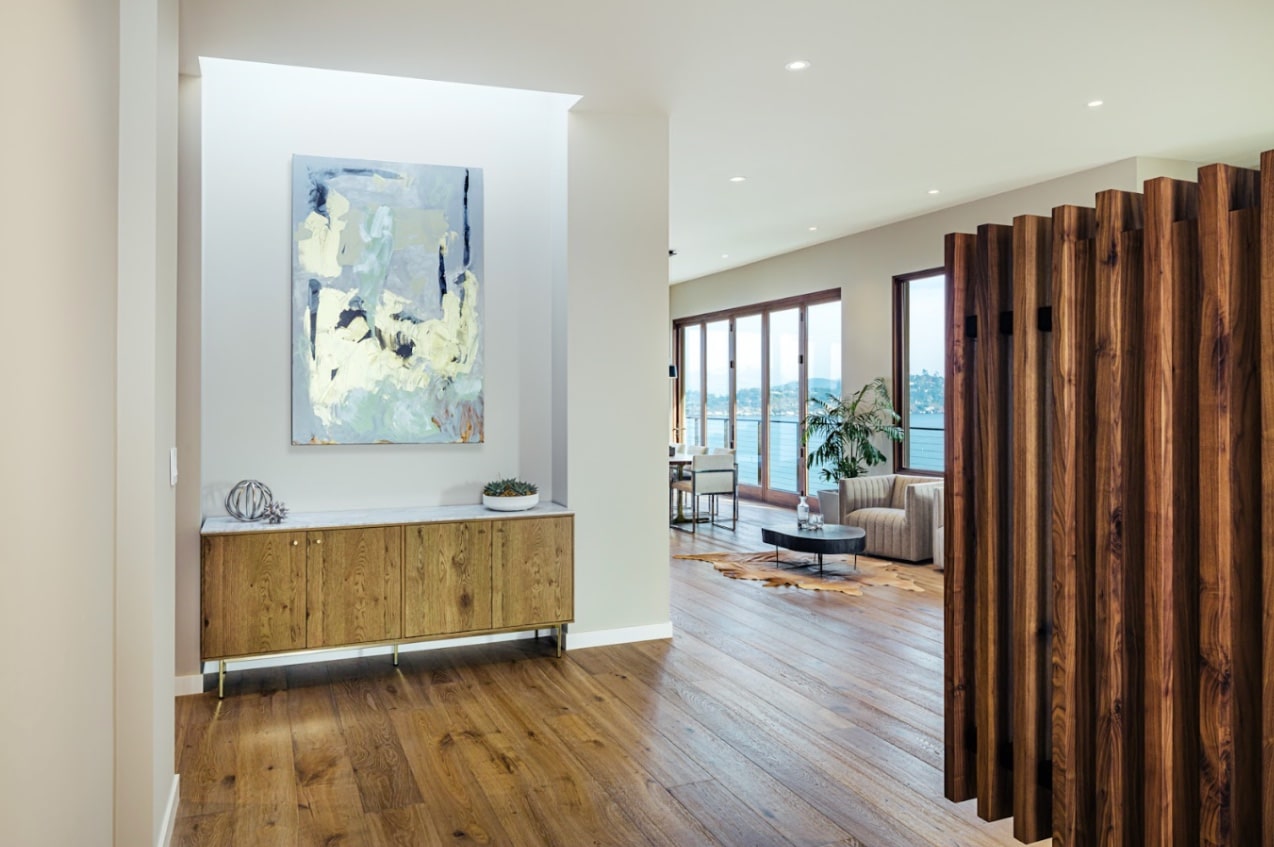
Light from the recessed skylight highlights a piece of modern art in the entryway of this ground up build in Mill Valley. The hidden skylight brightens the focal art wall across from the front door.
Skylight as Visual Accent in Mill Valley
The entry to this new construction is separated from the large front room by a wood-slat screen half-wall that creates a corridor as you walk in. You feel like you’re part of a larger room, even though you can’t see it all immediately. We wanted to curate the experience of entering the space by designing a visual cue for orientation.
The wood-slat wall directs the line of sight to the opposite wall rather than into the larger room, giving the opposite wall extra importance. By building an alcove for a piece of art, we created a dramatic moment and a sense of place for something beautiful. Adding a skylight that fit precisely at the top of the alcove allowed exterior light to shine down the alcove wall in a dramatic fashion and provide a beautiful focus.
The structural solution for this skylight was fairly simple, as the house has a flat roof. In order to maintain a little mystery about the source of the light, we elevated the skylight slightly to keep it out of sight as you enter. The resulting light can be ethereal or dramatic at different times of day.
Most homes have a wall that can function as a feature wall. A skylight can enhance the space or highlight materiality, adding to the wow factor. In the case of this home, the skylight brings a sense of wonder to the entry, providing an even glow with no shadow lines and taking your attention off the larger space for a few moments before you have fully entered.

A well-placed skylight creates an outdoor shower like experience in the middle of densely populated San Francisco. Located in the Castro neighborhood, this skylight adds design, function, and rejuvenating energy to this bathroom.
Skylight as Height Creator In the Castro District, San Francisco
The clients in this San Francisco Edwardian had just enough attic space in their three-story home to create a bedroom suite without committing to a full fourth-story addition. We needed dormers to create head height, but code only allowed dormers in a certain percentage of the roof—an allotment that was needed for the bedroom and closet. The bathroom location sits partially in the middle of the attic, the highest point in the roof, but by the time you reach the shower, the ceiling height has dropped dramatically.
Using a skylight allowed us to raise the useful ceiling height in the shower by adding the thickness of the roof structure to the height of the shower space. This simple, functional solution unlocked the client’s ability to use the attic level as a full bedroom suite and drastically reduced the cost by not requiring a vertical addition.
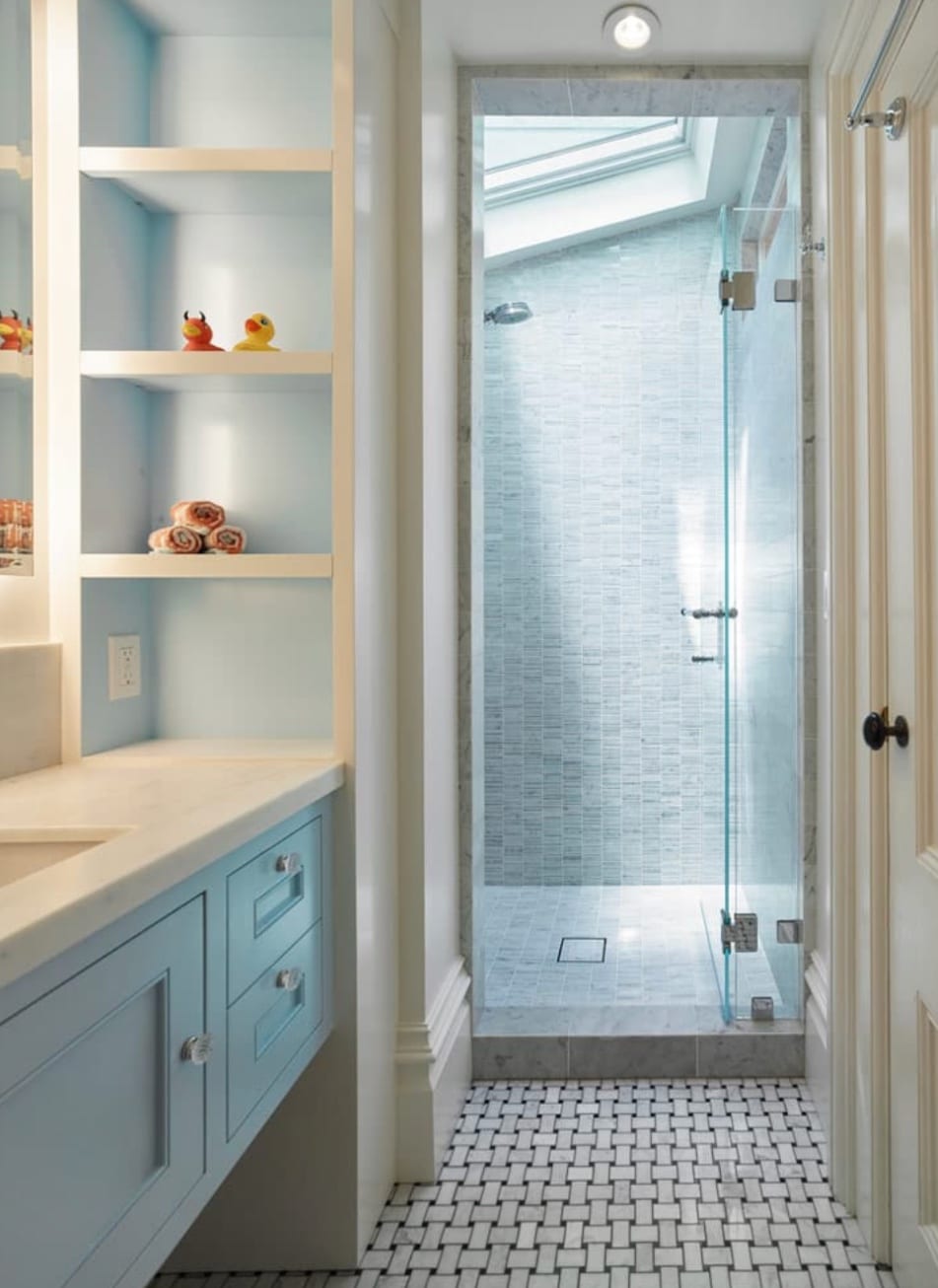
San Francisco spa-inspired bathroom with smart ventilating skylight, light blue accents, and carrera marble which is highlighted by the overhead sun.
Skylight as Space Definer in the Mission District, San Francisco
The owner of this classic San Francisco Victorian, located in the Mission District, wanted to add modern “bling” to her historic home. The guest bathroom was renovated to achieve this, incorporating a spa-inspired design and a smart ventilating skylight for improved function and design.
The lower level bathroom sits at the bottom of a lightwell, but the side wall is on the property line, so there was no opportunity for a window. Wanting to bring natural light into the space, we designed the room around the shower location—directly under the place where we could add a skylight. The skylight illuminates the Carrera marble tiles, creating a beautiful wall that pleases the eye as you enter.
By choosing an operable skylight, we allowed for ventilation and fresh air, as well as an effective way to deal with humidity and condensation. The standard-sized skylight has solar-panel controls, and creates a surprisingly bright room in the middle of the house on a lower floor—normally an impossible place to imagine natural light emanating from above.
This project was an interesting example of reversing the traditional process for situating a skylight. Instead of the location of the skylight being determined by the space below it, we started with where the skylight could go and changed the floorplan so that the light and ventilation could be priority for the shower.
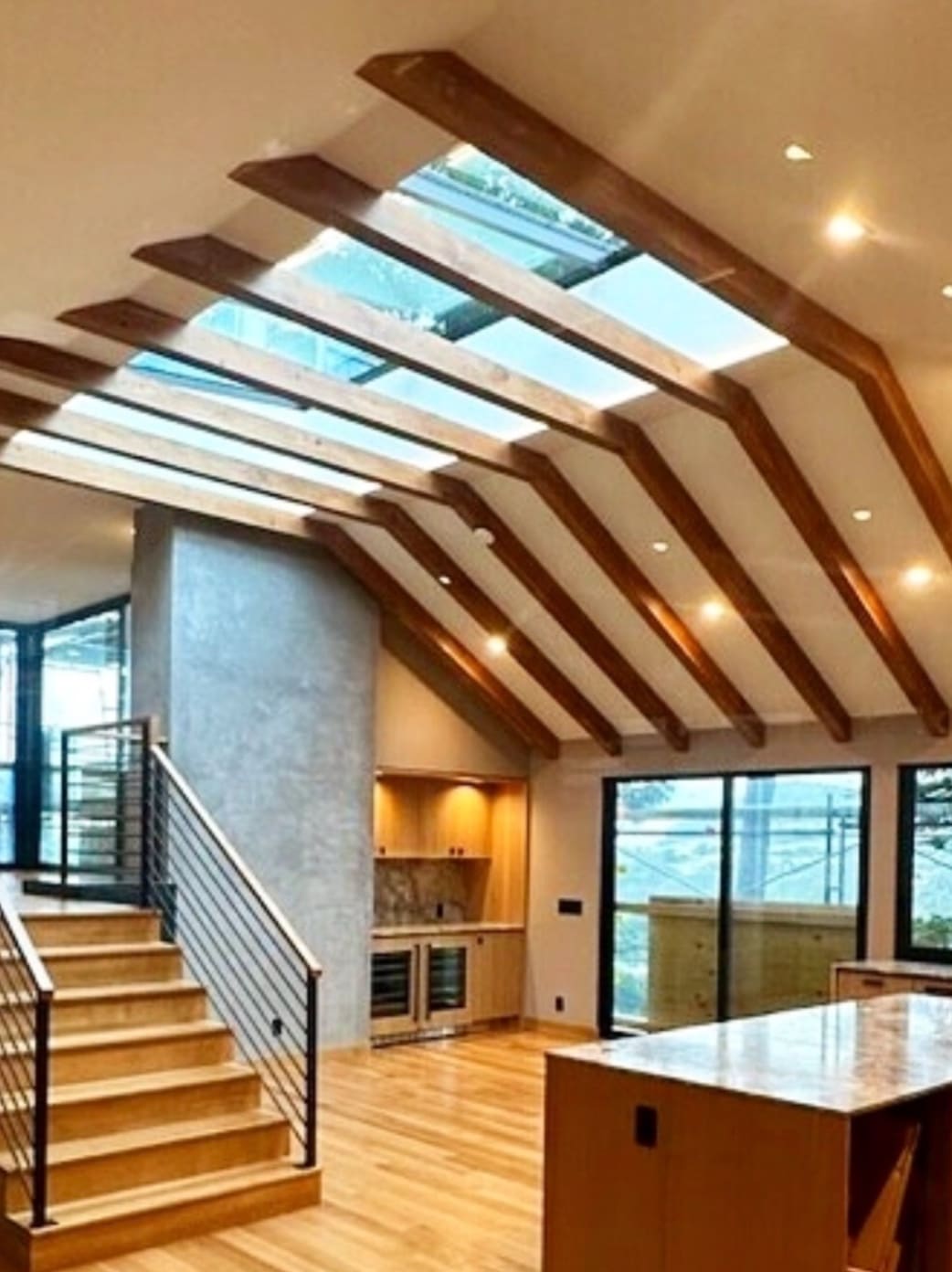
Even through construction, this vaulted ceiling skylight was the focal point of this remodel in the Forest Hill neighborhood of San Francisco. Dramatic wooden beams extend out from the ceiling and under the large skylight, which sits on top of the open floorplan kitchen and living space.
Skylight as Wow Factor in San Francisco
Disconnection between the kitchen and two adjacent spaces in this forested San Francisco home worked against the professional chef-owner’s love of cooking and entertaining. In order to meet the structural requirements for removing walls and opening up the space, the roof needed to be rethought. In that process, we decided to redesign the whole roof and add a very large skylight that matched the scale of the new, large room.
The tree canopy outside takes on a new brilliance when visible through the ceiling as well as the windows. Shadow and light play in the generous space, providing unlimited patterns and interest throughout the day. Shielded from direct sun by the branches, the skylight is less likely to heat up the room below. We also used beams to soften the big open expanse of both roof and skylight, creating texture, materiality, and warmth.
The skylight’s size added a couple of factors to the design. It’s not operable, and the large expanse of glass meant that the rest of the roof had to be over-insulated so that the average of the entire roof insulation value met code.
The client made a big commitment to redoing the whole roof to achieve the volume and light they were able to get from the large skylight, but its impact on the space is undeniable.
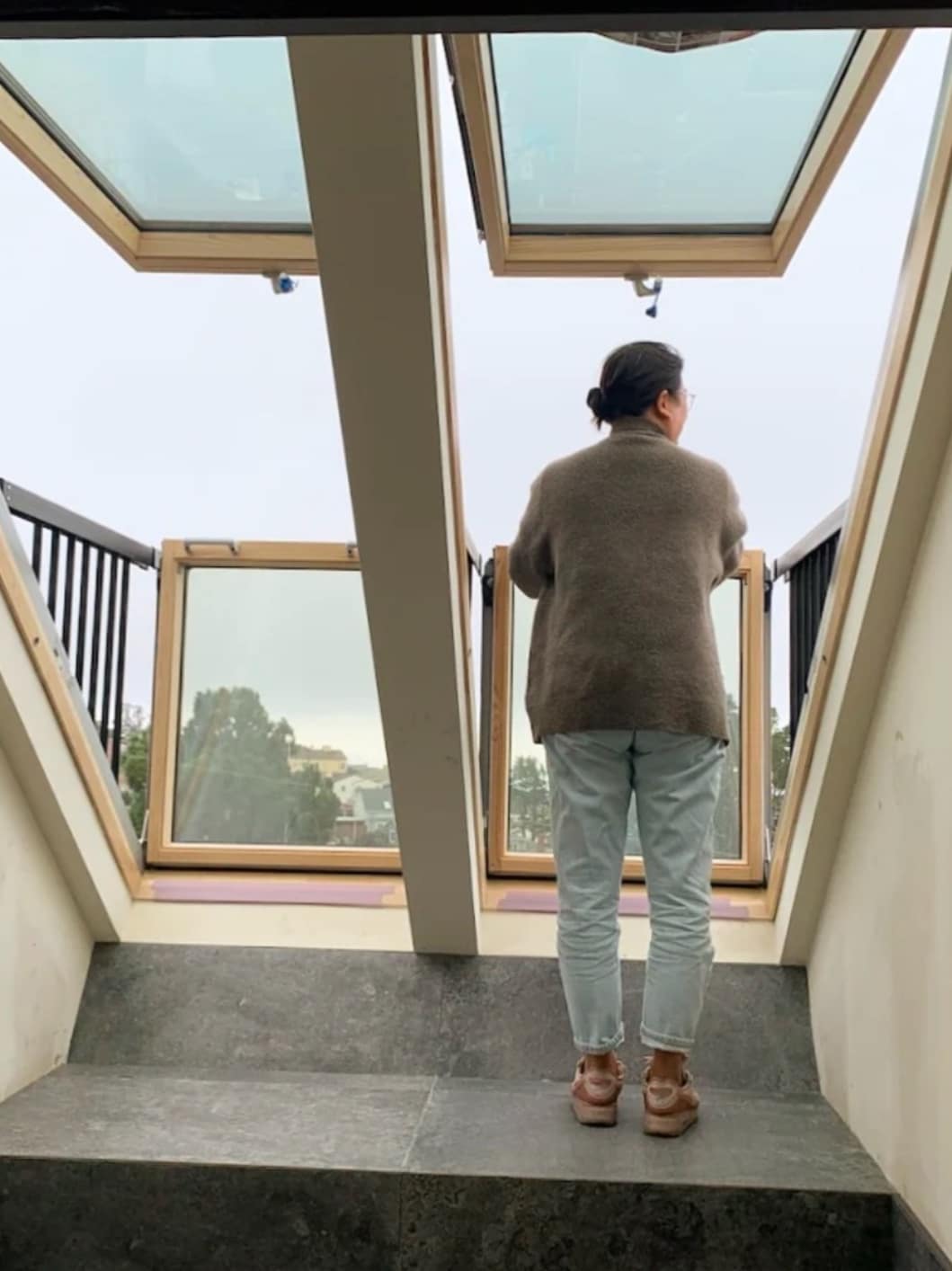
A unique Velux Roof Balcony skylight transforms this Kensington, California, home remodel by converting from a roof window into a private roof terrace. This innovative design maximizes natural light in the residential space, offering a unique architectural solution for bringing the outdoors in.
Skylight as Indoor-Outdoor Lifestyle in Kensington
A large, west-facing roofline with panoramic views offered an opportunity for a unique solution in the master bath of this East Bay, California home.
The room had an old plastic bubble skylight that gave nothing in terms of views. The owner wanted to not only see across the San Francisco Bay, but feel as if they were taking a bath outdoors. We used a pair of Velux ‘Roof Balcony’ skylights above the bathtub that creates the feeling of a small balcony when opened. The bottom of the glass flips out and brings side rails with it, while the top lifts up to create a canopy.
This solution allowed the owner to enjoy the San Francisco and Golden Gate Bridge view from their tub when the skylight was closed, and to feel like they were bathing outdoors when it was opened. It elevated the space from one that was lit by a skylight to one that was transformed by it.
Opportunities to use a roof balcony skylight don’t exist in every house, but in situations that can accommodate them and benefit from their unique design, they can be a game-changer for both light and views.
SKYLIGHT FAQs ANSWERED BY AN ARCHITECT
1) How much do skylights cost?
The skylight itself might range from a few hundred dollars to a few thousand for a custom or larger size. This doesn’t take into consideration the costs of installation, creating an opening in the roof, tying the roof into the skylight, drywall and painting around a skylight shaft, or any structural work needed. Installation is likely to range from a thousand dollars for a simple project and could go over ten thousand if structural upgrades, patching and painting, and other complexities are required. If you are installing a skylight as part of new construction it will be less expensive, as there is no need to retrofit existing systems to make it work.
2) Will a skylight make my home too hot?
That can happen. It’s important to be strategic about how you orient the skylight on the roof. In the summer, more sun and the heat it produces will hit the skylight and make it harder to control the heat in your house. They do make integral shades which can help but are more effective for light than heat because the shade is on the interior of the glass so the heat has already come inside the house when it hits the shade. In the winter, however, skylights can bring in the sun’s rays when it’s cold outside and nicely warm the house without turning the heat up a few more degrees.
3) Do skylights require structural upgrades?
In most of California, yes. Although they may not be in other parts of the country, earthquakes are a major structural factor to address and additional support is needed for openings in roofs in San Francisco and most of the west coast. This can involve reinforcing the roof rafters, adding wood blocking around the opening, and even adding metal straps. All of that requires access to the roof framing. If you have an attic, you have to create two openings, one in the roof and one in the ceiling, and build the skylight shaft between them with sheetrock walls.
4) What is the lifespan and maintenance expectation for a skylight?
Skylights should last as long as a roof. Skylights themselves are well built if they are not too inexpensive. Plastic skylights are not as durable as glass – their best use might be in a garage or another unfinished space.
5) What happens with high winds if I have a skylight?
The arm that holds skylights open is not designed to withstand high winds, so the key is to close the skylight before the winds kick up. A closed skylight shouldn’t be a problem.
6) How does a skylight affect airflow in a house?
Operable skylights provide effective ventilation, creating a natural fan effect when a window or door elsewhere in the house is opened, especially if that is on the bottom level and opens to a cool area like the north side of the home. In San Francisco, many windows open to light wells which stay cool and are a good complement to an operable skylight.
7) Do I need to be concerned about seismic issues when installing a skylight?
Yes, where seismic issues govern structural codes like in the SF Bay Area, you have to pay attention to the blocking around the skylight. A skylight is essentially a hole in the roof, so it’s a weak point. Generally a skylight has to be quite large to create an issue, but all sizes need to be blocked.
8) Can my roof support skylights?
Mostly yes. Adding a skylight to an existing roof necessitates a review by a construction professional or architect. For an older home in San Francisco, adding a skylight usually involves adding additional rafters to the roof framing around the skylight. This can be tricky unless the attic access is easy.
More modern homes might just require additional blocking on the sides of the skylight.
9) How do you waterproof skylights?
Skylights themselves come waterproofed, but during installation the roofer will need to either seal the skylight’s curb into the roofing or, for deck-mounted installations, tie it into the roofing membrane. Once the curb is built, the skylight just pops over the top of it and screws in.
10) What is a reasonable warranty on a skylight?
It should be the same as a reasonable roof warranty. Velux, a major skylight manufacturer advertises a 10-year warranty on product and installation, with 20 years for the glass and 5 for blinds and other special features. With both roofs and skylights, the shingles or skylight themselves won’t usually fail—it’s the joints and seams between the shingles or the skylight and the roof that need maintenance, often before the warranty period is up.
11) Will new skylights require a permit?
Yes. In San Francisco, for instance, anything costing over $500 requires a permit, and this is true in other municipalities, as well. It should just require a building permit, not planning department approval, but different municipalities have different rules, so you have to check your local governing body.
12) Can I put a skylight on an older home?
Yes. You will generally need some structural upgrades and reinforcement, but you can do it. In San Francisco, it’s common for older homes such as Victorians or Edwardian buildings to add skylights into older structures to help modernize these older spaces.
13) How does the type of roofing you have affect installing a skylight?
The simplest roof type to integrate a skylight into is asphalt shingles or an asphalt membrane roof used on a flat roof (although you will need to build a curb). The most difficult is Mediterranean tile roofing, but it’s still possible to install with a curb. Metal roofing and other single ply membranes are also relatively straightforward to integrate a skylight into.
14) What costs should I be aware of besides the price of the skylight?
Labor is likely 1 to 5 times the cost of the skylight when looking at the overall cost and it can even get higher than that in involved installations. You will need to build in the cost of any labor associated with the following items: demolition, framing the opening (both roof and ceiling, if necessary); integrating the skylight to the roofing membrane (i.e. waterproofing); construction of a skylight shaft; and sheetrock and painting (you often have to paint the entire ceiling or you will see difference between old and new paint). If the location of the skylight conflicts with a ceiling light fixture, you might have to move the fixture and rewire, opening a section of wall, in addition to some of the ceiling.
15) What is the best orientation for a skylight?
This depends on what kind of light you want to bring in. Facing north in the northern hemisphere, a skylight won’t bring in direct sun rays and can provide a nice, soft glow of light. Facing south means more dramatic rays of light and more heat gain. East and west sun angles are lower and the light might not be as direct. The questions you need to answer for yourself, if you have a choice as to the orientation, are do you want more direct light or more diffuse, and morning or afternoon sun (cooler and warmer, respectively). Additionally you’ll want to consider the room the skylight will light. Do you want direct light in your bedroom in the morning? What about the bath?
16) How is skylight performance rated?
The skylight performance is measured in a few ways: 1) U-Factor is used to rate the insulation value; 2) Solar Heat Gain Coefficient (SHGC) – how much solar heat enters through the glass; and 3) Visible Transmittance (VT) – how much daylight passes through.
Since skylights have a lower insulation value than the roof assembly and are essentially a hole in the roof, they slightly decrease the insulation rating of the entire roof. It’s the same idea as a window rating, but you lose and gain more heat through the roof than your walls, so there is more of an effect from skylights.
17) What mistakes should I avoid when considering a skylight?
Capturing the wrong kind of light for your goals would probably be the biggest mistake one could make. There are lots of ways a skylight can add light to a room, and you want to consider them carefully. You could have a wash of light along a wall or in the middle of a room. Light on a wall can make the room feel brighter because we visualize what we can see, which is more likely to be a bright wall than a bright floor. Also, the drywall finish needs to be smooth if you are washing the light down a wall because the light will emphasize irregularities in the finish.
You can also make the mistake of not pitching the skylight so that rainwater drains off it and doesn’t spot as much. Or you might install a fixed skylight and miss the benefit of ventilation that an operable one would offer.
18) Do I need to prevent condensation under a skylight?
No, Modern windows and skylights generally don’t have condensation problems because of the vacuum-sealed double-glazing, so it would be unusual to have condensation problems with a new, dual-pane skylight.
19) What about in a bathroom where it’s humid?
Actually, a bathroom is a great place for an operable skylight to exhaust the steam buildup to help reduce the humidity.
20) Do skylights increase the noise level in a house?
Yes, You’ll hear a little more noise during a rainstorm. Skylights are a hard surface without much insulation between outside and the interior air space. The dual-pane glass should dampen the sound a bit, and some glass coatings have been shown to help, as well, but expect them to be noisier than the main roof..
21) Are there sustainability issues related to skylights?
Yes, skylights can definitely be part of a system that helps save on energy costs. They can be part of a passive heating/cooling system which means you can use your heat or air conditioner less often and bring in more natural light to dark, interior spaces means turning on the lights less often during the daylight hours.
22) Is there any reason not to install a skylight?
Yes, the cost might be too high for your budget or you might not want to install them over places where light can be damaging, such as closets. A skylight is another hole in the roof, another potential place for leakage, and roofs are more likely to fail due to lack of maintenance at the roof openings. While leaking skylights are not common, adding one to your home comes with the responsibility of maintaining it to retain its essential functions of providing light, air and space to your home
23) Do I need to worry about skylights and wildfires?
Yes, During a wildfire, an open skylight can be a place where embers can enter the home. Dual-pane glass skylights will be more resistant to fires. Plastic skylights are more vulnerable to wildfires due to their combustibility. Installing a smart skylight can help in being able to open or close your skylight remotely, as well as using glass that is specifically rated for heat exposure.
24) How do I know if a skylight is for me?
If you want to bring in additional light, ventilation, and passive cooling or heating into your home and have the budget to afford adding a skylight, then yes. If there are opportunities to utilize incoming light as a design feature in your home, then yes. If you’ve got the ability and resources, adding a skylight is a home upgrade option that can change and improve the look, feel, and liveability of your home.
As you can see, there are numerous ways to incorporate skylights into your home. There is no right or wrong answer as to whether a skylight is for you, but the conditions of your home and the benefits you are seeking will move you in the direction of either adding a skylight or not, and choosing the type. There is no doubt they are a recognizable addition to any space—the trick is finding the right combination of factors for you.